- Jessica Plummer Writes
- Posts
- Queer Superhero History: X-Statix Buries Its Gays
Queer Superhero History: X-Statix Buries Its Gays
Bloke, Vivisector, and Phat. Yes, Phat.

Jessica Plummer
April 08, 2026
It’s time for another installment of Queer Superhero History, where we look back at queer characters in mainstream superhero comics, in (roughly) chronological order, to see how the landscape of LGBTQ+ rep in the genre has changed over time. Today, we’re taking a look at several early 2000s Marvel characters: Bloke, Phat, and Vivisector!
Listen. I know these guys are obscure, but we need to talk about them. Last month, I wrote about how in the early 2000s Marvel, historically less open to queer characters than DC, finally started to include explicit queer characters who weren’t Northstar in some of their alternate universes. But they also introduced some brand-new queer characters into their main “616” universe.
With, um. Mixed results.
The characters we’re looking at today are all mutants, first introduced in X-Force. X-Force is a long-running X-Men book that’s usually known for being violent and edgy, but in the early 2000s, there was a brief run by Peter Milligan and Mike Allred that reimagined X-Force as a satire inspired by reality TV. After about a year, this lineup was spun off into a new book, X-Statix.
All three characters below were introduced in X-Force #117 (August 2001).
Bloke
Bloke, a.k.a. Mickey Tork, is super strong, with color-changing skin. The page that introduces him is, uh, not subtle. He’s from San Francisco! He used to go by “Rainbow” but now prefers to be bright pink as a default! He has “impeccable taste in soft furnishings” and a “penchant for musical theater!” It’s like a checklist of stereotypes.
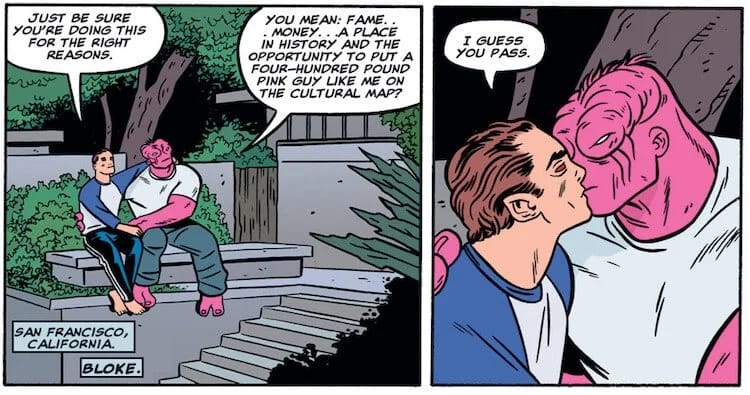
The first gay kiss in a Marvel comic, as far as my research has been able to turn up. [X-Force #118 (July 2001), art by Mike Allred.]
But just in case anyone missed the implication, in #118, Bloke is shown with his boyfriend for exactly two panels. The boyfriend is not named, but he is visibly a mutant. More importantly, in the second panel, the two of them share a kiss: the first gay kiss in a Marvel comic.
Later in the issue, Bloke is killed in battle. There wouldn’t be another male/male kiss in a Marvel comic for eight years.
To rub salt in the wound, shortly before the fight that kills him, Bloke makes an innocuous comment about finding men attractive, to which his teammate Phat (more on him in a second) reacts with disgust. As Bloke lies dying, Phat tries to comfort him, and Bloke says “One less of my kind to worry about, right?”
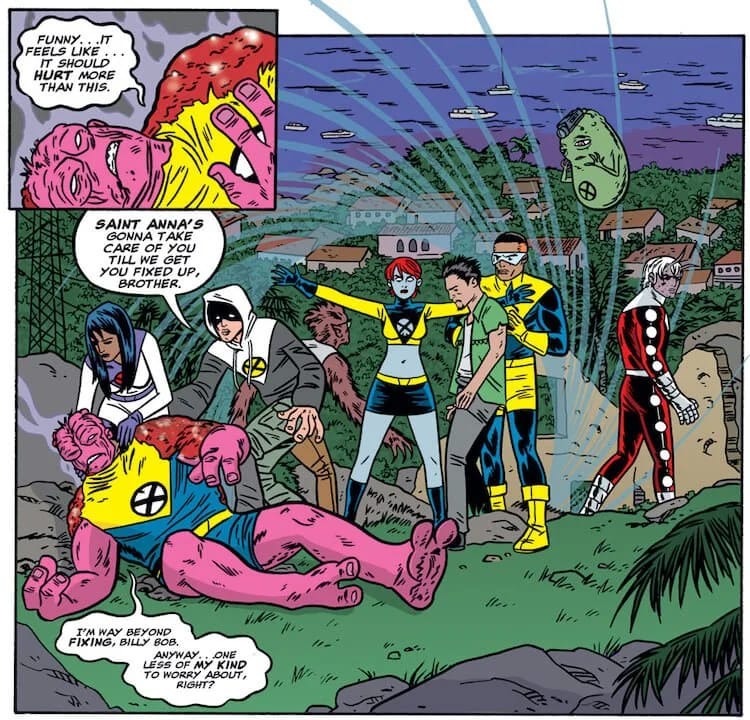
Welp. [X-Force #118 (July 2001), art by Mike Allred.]
Bloke was half of Marvel’s first gay kiss (and second ever canonically queer superhero!), and that matters, even if most people don’t remember it. That’s pretty much the only positive thing I can say about his portrayal. He shows up for exactly two issues, just long enough to be the butt of a barrage of stereotypical jokes, and dies teaching another character a valuable lesson about homophobia. And I can’t help but wonder whether that kiss would have even been allowed if Bloke hadn’t been slated to die just a few pages later. The saddest part is that this was genuinely boundary-pushing for Marvel (and really, comics in general) at the time.
I’m not sure I can unequivocally say that the series got better about queer rep, but it certainly got…weirder.
Phat and Vivisector
The aforementioned Phat is William Robert “Billy Bob” Reilly (or sometimes “Billy-Bob”), who can make any part of his body fatter, which is exactly as silly of a power as it sounds. Billy Bob is a parody of a very specific type of white guy in the 90s and early 2000s who adopted Black hip-hop slang, fashion, and culture, for which there was a term that for some reason we all thought was okay to say at the time; the Offspring’s “Pretty Fly For a White Guy” and Seth Green’s character in Can’t Hardly Wait are good examples of similar parodies.
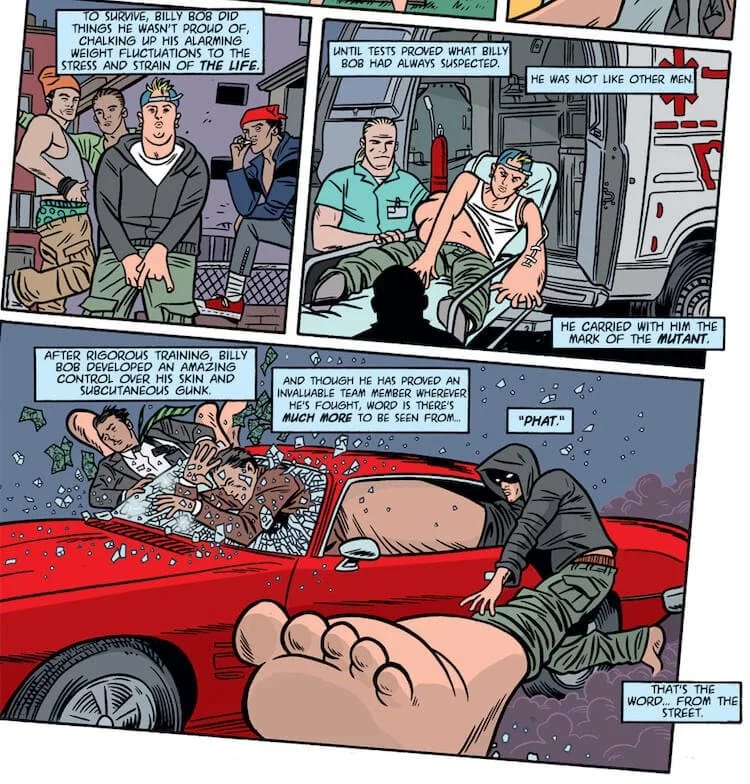
If you weren’t there, I cannot convey to you how extremely 2001 this all is. [X-Force #117 (June 2001), art by Mike Allred.]
Vivisector is Myles Alfred, a brilliant Harvard literature student and basically a werewolf; his introduction describes him as “Author of a critically-acclaimed pamphlet on Walt Whitman and able to tear through steel walls with his teeth and claws.” (I don’t think the Walt Whitman thing is a hint, since I don’t think Whitman’s probable sexuality was widely known in 2001, but who knows.)
Phat and Vivisector are basically the background comic relief to more central characters—something they’re actively aware of, since like I mentioned, this era of X-Force was basically a reality show. They decide to turn the the spotlight on themselves, and in #126, confess to the rest of the team that they have “special feelings for each other.” In #127, however, it’s revealed that they’re only pretending to be in a relationship for media attention.
Or are they? In #129, the final issue of the series, we see them in bed together, clearly disconcerted. Later, Billy Bob reacts with angry denial and homophobic language when a reporter asks about their relationship. He tells a pissed Myles that he doesn’t want everyone knowing, even though that was the whole point, because they aren’t pretending anymore.
This subplot continues into their next series, X-Statix, where Billy Bob is uncomfortable in the team’s communal showers and struggles to access his powers, which Myles blames on him “denying your true self.” Myles isn’t as sanguine as he pretends, though, getting drunk and describing himself and Billy Bob as “in a state of gay slash not-gay: multi-sexual cats in Schrodinger’s Box.” Finally, in X-Statix #4, they talk it out off-page and cheerfully explain to the team that they are both gay…but not for each other.
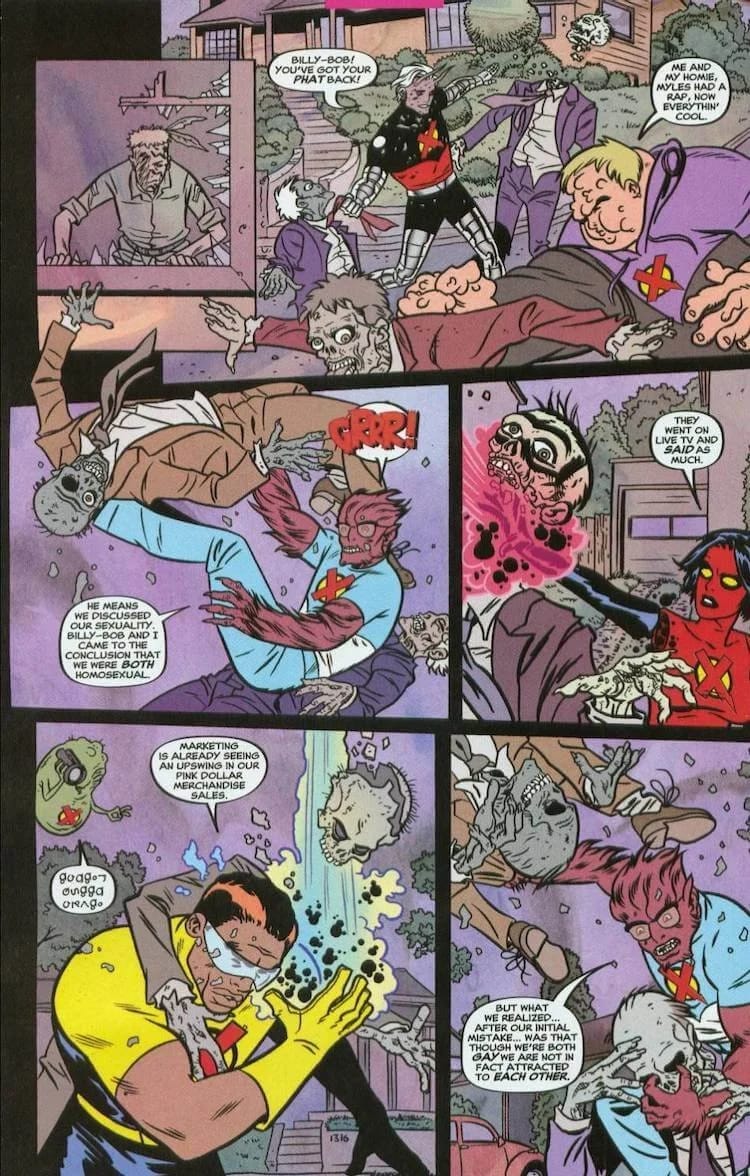
Genuinely a delightful reveal! Zombies and everything! [X-Statix #4 (December 2002), art by Mike Allred.]
I don’t want to overstate this plotline; it’s mostly a bunch of throwaway gags around the edges of the book’s main plot and central characters. It is, however, the first funny gay joke the comic has managed. It’s a fun and unexpected twist that does a lot to humanize both Billy Bob and Myles.
Unfortunately, as Northstar probably could have told them, being gay did not actually put anyone front and center in Marvel comics of the era. They recede into the background again, with the occasional throwaway gay joke. (Myles develops a crush on a teammate whose codename is “El Guapo”—literally, “the Handsome One!” A different teammate implies that Billy Bob only saved a female pop star’s life because he’s gay and therefore must be a fan! You get it.)
Finally, in #18, Billy Bob dies. There are a bunch of jokes about it. (“He was white but he wanted to be black. And that’s what made him blue.”) Most tastelessly, a fight breaks out at his funeral as “gay rights and fat activists both claim him as their own.” Both groups are depicted as raging stereotypes.
Phat was never going to be a character with a lot of mileage. He was designed to parody a very specific cultural phenomenon that was already waning as a trend when he debuted. If I’m being generous, I could say that he consists of two one-note jokes, because you can also make fat jokes about him…which isn’t really any better. His brief faux romance with Myles and subsequent coming out is the only time he rises above those two punchlines, and it only lasts for a handful of pages. It’s not a huge surprise that a character with such a lack of versatility was written out of the book, but the fact that this team now had two gay heroes in a row killed off is not a great look.
Myles, on the other hand, is just smart and sarcastic, which means he has a lot more potential. Interestingly, Billy Bob’s death is followed immediately by Myles getting the narrative spotlight for a two-issue arc, the only time he would ever do so. In #19, he decides to have a scientist “cure” him of his mutation, despite the fact that being a mutant has made him famous—and, we learn, gotten him a heartthrob boyfriend, teen soap star Brandon Cody. But, as with so many things in superhero comics, it all comes down to daddy issues. “Dad made me feel…subhuman…a monster,” he says at one point. And then, in a later scene: “All my life, I’ve felt as though I’m not good enough!”
In the aftermath of the cure, Brandon immediately dumps him—pretty transparently because Myles doesn’t benefit his career anymore, but he also draws the obvious analogy: “What else are you gonna try to cure, Myles? Your sexuality? Maybe you think that’s a curse, too?” Myles’s mother makes the same link in #20, eagerly asking “We were wondering if…this cure…got rid of that other thing, too.” And Myles’s father describes Myles as “someone who prostitutes his perversions on television.”
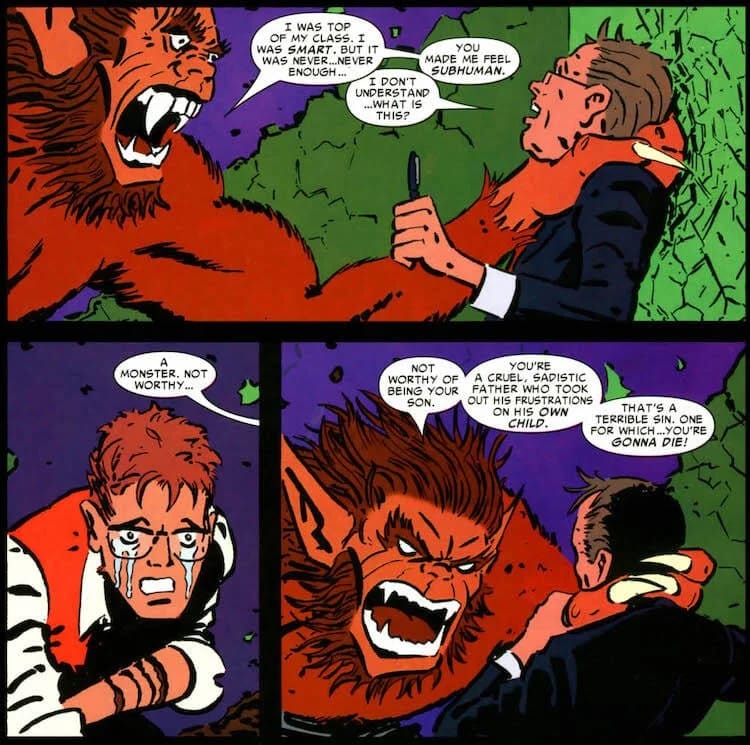
The ersatz Vivisector tells Myles’s father everything Myles can’t bring himself to say. [X-Statix #20 (May 2004), art by Nick Dragotta.]
Because this is a superhero comic, the mad scientist who removed Myles’s mutation has obviously injected it into himself, turning himself into a feral werewolf who thinks he’s the real Vivisector and wants to kill Myles’s terrible father. Myles kills the scientist, tells his dad what he really thinks of him, regains his mutation, and meets a cute boy named Raju who admires his work on Emily Dickinson. It’s fun!
But Myles and Raju didn’t last long. X-Statix was canceled in 2004, with the whole team seemingly dying in battle. A decade and a half later, they returned in a one-shot called Giant-Size X-Statix in 2019…sort of. Unlike the rest of the Marvel universe, X-Statix seems to have aged in real time. A now middle aged Myles is (inexplicably) one of only two surviving members of the original team, and the rest have been replaced with their children. (Phat, we learn, has a cloned daughter called “Phatty” whose page time consists pretty much exclusively of fat jokes.) Myles has become a successful writer of “difficult postmodern novels” as well as something called Super-Heroics, Homosexuality and Fate, and is now married to a sweetly supportive man named Fenton.
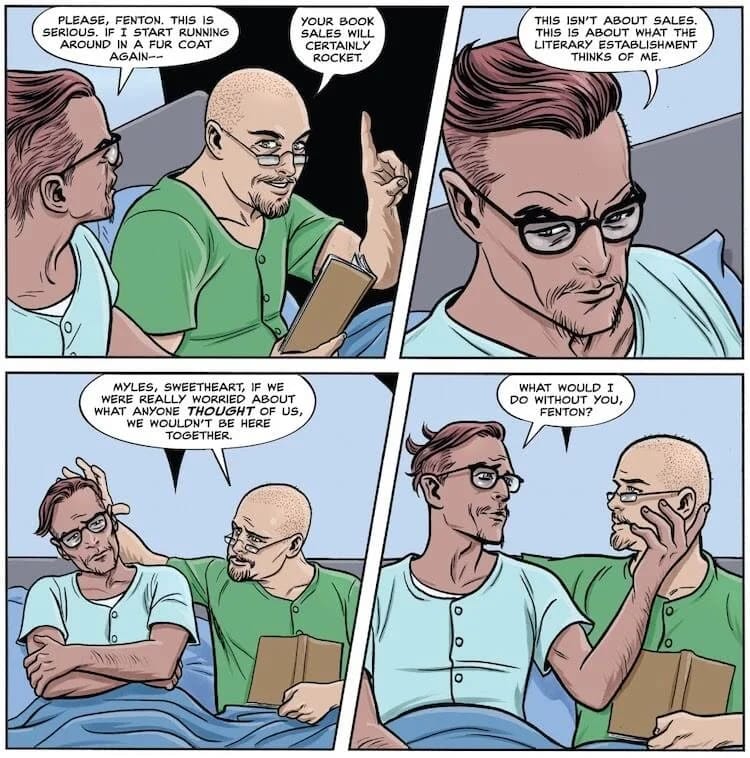
Myles and Fenton. I love the subtle aging Allred has done on Myles here. [Giant-Size X-Statix #1 (September 2019), art by Mike Allred.]
Giant-Size X-Statix was followed by two five-issue miniseries in 2022 and 2023 respectively, both called The X-Cellent. Over the course of the new issues, Myles falls back into his role on the original team of issuing wry commentary from the background. There are still gay jokes, but they no longer rely on stereotypes or making Myles the butt of them. I was pleasantly surprised!
And then in the final issue of the second The X-Cellent miniseries, Vivisector, like Bloke and Phat, dies. Again.
There’s a media trope called “bury your gays,” which Wikipedia describes as “queer characters fac[ing] tragic fates, including death, much more often than straight characters.” The trope arose under censorship, both unspoken and explicit; both the Comics Code and the Hays Code for film forbade the depiction of queer characters, meaning that queerness could often only be even hinted at if the queer character—whether sympathetic or not—was ultimately punished by death.
Now, all of the X-Statix books are irreverent satire, with no subject too tasteless to joke about. And there are certainly plenty of straight members of the team who die. The entire team died in 2004!
But there’s a difference between a whole team being killed at once, and every single gay member being killed off one by one. Bloke, Marvel’s second queer superhero and one half of their first queer kiss, is almost immediately safely eradicated—a death that teaches Phat a very special lesson. (And yes, Phat would turn out to be queer as well, but readers wouldn’t know that for another year.) Vivisector is depicted as settling down twice, first with Raju and then with Fenton, before being murdered. Twice.
Bloke, Phat, and Vivisector are almost completely forgotten today, which isn’t a surprise: they’re obscure characters from an obscure book who were written with a lot of harmful, thoughtless tropes. But I don’t write the Queer Superhero History series just to celebrate the triumphs. I write it to paint a picture of what queer rep in comics has looked like over the decades, even when it’s unpleasant—and to highlight that superficial improvements in how queerness is depicted now don’t always indicate progress. The Vivisector of the 2020s is a more human portrayal of a gay man than that of the 2000s, but that doesn’t make him any less dead. (For now. This is comics, after all.)
All that said, queer rep at Marvel would improve over the years, but not right away, and not always linearly. Fasten your seatbelts, folks…it’s gonna be a bumpy decade.