- Jessica Plummer Writes
- Posts
- Queer Superhero History: Poison Ivy and Harley Quinn
Queer Superhero History: Poison Ivy and Harley Quinn
Supervillainy's most beloved gals who are pals

Jessica Plummer
December 17, 2025
It’s time for another installment of Queer Superhero History, where we look back at queer characters in mainstream superhero comics, in (roughly) chronological order, to see how the landscape of LGBTQ+ rep in the genre has changed over time. Today: Harley Quinn and Poison Ivy!
Harley and Ivy are one of the most popular queer couples in comics, but if you ask the internet when they became an official, canon item, you get about two dozen different answers. It’s a testament to how extremely overt the subtext and innuendo was between them for so long—and also to how the goalposts tend to shift when it comes to queer characters and representation “counting.” So let’s take a look at these two infamous gals being pals.

Harley and Ivy’s first undeniably canon, undeniably romantic, undeniably on-the-lips kiss. It took us quite a while to get here. [Batman: Urban Legends #1 (May 2021), art by Laura Braga.]
Poison Ivy was introduced in Batman #181 (June 1966) by Robert Kanigher, Sheldon Moldoff, and Carmine Infantino. Originally a fairly one-note femme fatale, she eventually evolved into Pamela Isley, a brilliant botany student whose professor and lover, Dr. Jason Woodrue, experimented on her, giving her power to control plants and secrete plant-based toxins. She currently straddles the line between antihero and ecoterrorist, defending the natural world against humankind, and also has a connection to the Green, the elemental force that links all plant life.
Harley Quinn debuted on Batman: The Animated Series as a sidekick to the Joker. Created by Bruce Timm and Paul Dini and voiced by Arleen Sorkin, she first appeared in the 1992 episode “Joker’s Favor,” but quickly became a fan favorite. The standalone comic Batman: Mad Love, which was later adapted into an episode of the show, gave her origin: she is Dr. Harleen Quinzel, a psychologist who fell in love with the Joker while attempting to treat him and turned to a life of crime to please him.
Harley was folded into the main DC universe in 1999. After years stuck in an abusive cycle with the Joker, she’s developed over the past decade into an independent character with a ton of her own comics, her own live action movie starring Margot Robbie, and a current multi-season animated series. DC Comics publisher Jim Lee has called her as important to the company as Superman, Batman, and Wonder Woman. Not bad for a one-off gag character!
Harley and Ivy first met in the 1993 BTAS episode “Harley and Ivy,” where Harley, on the outs with the Joker, teams up with Ivy for a crime spree. This would set the tone for their interactions for the next 20 years or so, with Ivy encouraging Harley to leave the Joker and his abuse behind, and Harley continually returning to him. Notably, Ivy also injects Harley with something that will keep her from being poisoned by proximity to Ivy, which would go on to be a font of endless innuendo. The duo teamed up again in the 1997 episode “Holiday Knights,” and honestly, if you haven’t seen it, please stop reading this article right now and go watch it. It’s a delight.

“Play.” [Batgirl Adventures #1 (February 1998), art by Rick Burchett.]
Fans shipped Harley and Ivy almost from the start, and Harley’s creators and BTAS showrunners Bruce Timm and Paul Dini encouraged it with plenty of winks and nudges. In the one-shot tie-in comic Batgirl Adventures (February 1998) written by Dini, Harley and Batgirl team up to rescue Ivy from rival terrorists. Batgirl asks if Harley is worried about how dangerous Ivy is, and Harley dreamily replies: “Oh, Ivy can’t hurt me. She gave me a special shot once so we can play and I won’t get sick at all.” Batgirl awkwardly asks if that means Harley and Ivy are friends or friends, to which Harley asks “Like what everybody says about you and Supergirl?” (Batgirl hastily drops the subject.) In Batman: Harley and Ivy #1 (June 2004) by Dini and Timm, we see the two women in the Arkham showers, complete with Harley shampooing Ivy’s hair and snapping her butt with a towel—a slapstick take on the women’s prison sexploitation trope.
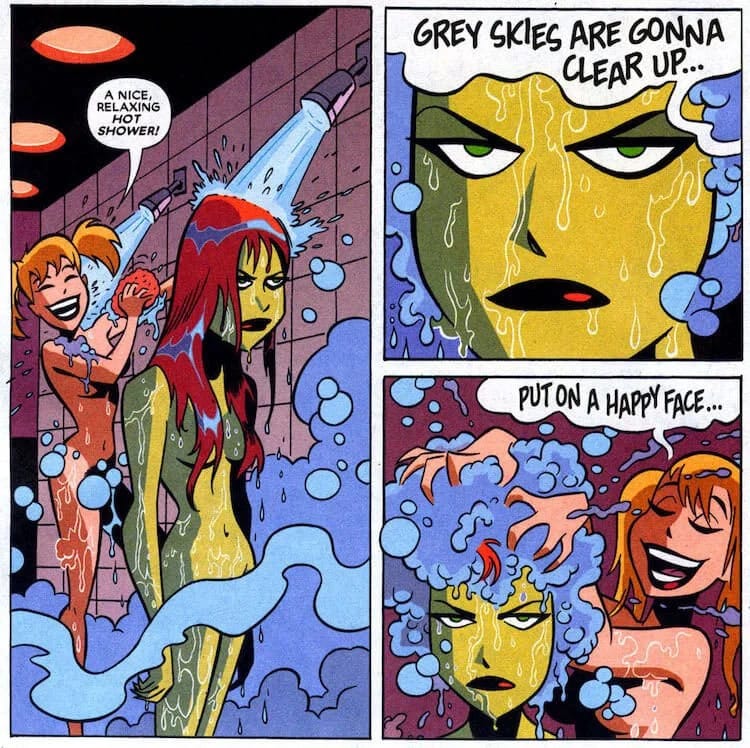
These panels still make me laugh. They also, I assure you, were WIDELY shared in throughout the comics internet of 2004. [Batman: Harley and Ivy #1 (June 2004), art by Bruce Timm.]
Sapphic subtext had existed in comics for years, but these overt sex jokes—and with characters from a children’s cartoon, no less—were pushing the envelope in a big way. And sure, it was for humorous titillation rather than heartfelt queer rep…but when you suggest two women are sleeping together over and over, eventually people are going to start believing it.
(Sidebar: in a 2005 comic set in the main DCU, Ivy kissed Supergirl while wearing synthetic kryptonite lipstick in a (failed) attempt to control her. Once again, this is purely for reasons of titillation (despite Supergirl being only 16 at the time, sigh), but it’s worth noting that Ivy was DC’s go-to at this point for a girl-on-girl kiss. And that she kissed Supergirl on-page years before she kissed Harley.)

Later on I’m going to talk about the good kind of fan service. This is the bad kind. [Supergirl #0 (October 2005), art by Ian Churchill and Norm Rapmund.]
As the years went on, DCAU went away, but the subtext between the main DCU versions of the characters remained—and got increasingly less sub. In Gotham City Sirens #24 (August 2011), during yet another confrontation with the Joker, Ivy begs Harley to leave him once and for all. Harley asks why Ivy is so invested in this, so dedicated to their friendship. “Is it because you love me?” she whispers in Ivy’s ear, which throws Ivy off so badly that Harley is able to sucker punch her and get away with the Joker. In the next issue, Ivy admits to herself that she does love Harley, although the nature of that love isn’t defined.
In 2013, Harley got a solo series written by Jimmy Palmiotti and Amanda Conner, a creative team who never met fan service they didn’t want to deliver on. Ivy’s first appearance in the series has her greeting Harley with “Kisses, please” and ends with them sleeping in the same bed. A few issues later we see them on a bed again, with Ivy wearing just a towel while trying to guess the login info for a locked computer file; Harley puts her head in Ivy’s lap and suggests “kiss me” and “now.” Pet names and cheek kisses abound.
In issue #15 (May 2015), Harley affectionately tackles Ivy to the floor and straddles her. “Are you gonna get off?” Ivy asks as their faces get closer together. “Are you?” Harley replies. Their hands are conspicuously not visible. On the very next page, Harley calls Ivy her girlfriend…while talking to a male love interest. Plausible deniability, or are they just poly? DC actually confirmed the latter a few months later, when the official DC Twitter account replied to a fan question with the slightly bizarre phrasing of: “Yes, they are Girlfriends without the jealousy of monogamy.”

I challenge you to imagine a male/female duo doing this and a significant portion of the audience going “Well…maybe they’re just really good friends.” [Harley Quinn #15 (April 2015), art by Chad Hardin.]
The replies are…enlightening. (This was back when Twitter was only partially a trashfire.) Some fans loved the confirmation; some angrily denied it. But fascinatingly, some accused DC of queerbaiting, because it hadn’t been confirmed in a comic, even though Harley and Ivy had been depicted pretty obviously feeling each other up on page and referring to one another as girlfriends.
Now, you can certainly chalk this up to the unreasonability of the average Twitter user. But I think it also speaks to queer readers’ understanding that queer characters and queer relationships have a much higher bar to “prove” that they are canon. The narration might refer to Arnie Roth having a male lover; Cannon and Saber might call each other “love”; John Constantine might talk about ex-boyfriends. But plenty of readers, and often the publishers themselves, can still ignore those moments, or misread them, or explain them away.
This anxiety is on full display in this impressively curated listicle of every single Harley/Ivy kiss through July 2023 that was published on the official DC website, of all places. “But first, let’s set some ground rules: No pecks on the cheek. No foreheads. No innuendos. No plausible deniability of ‘gals being pals.’ This list is solely full-on, undeniable, queer mouth-to-mouth contact,” says writer Alex Jaffe. The emphasis is mine because I find that sentence so fascinating. The preemptive exhaustion over the imminent “um actuallys” is practically audible. No, these aren’t just joke kisses. No, you can’t explain them away. Yes, they are queer. Even twenty-six years after the first innuendo and eight years after being confirmed by the publisher (and, I would argue, on the page), Jaffe knows that some people are going to try to rules lawyer this away.
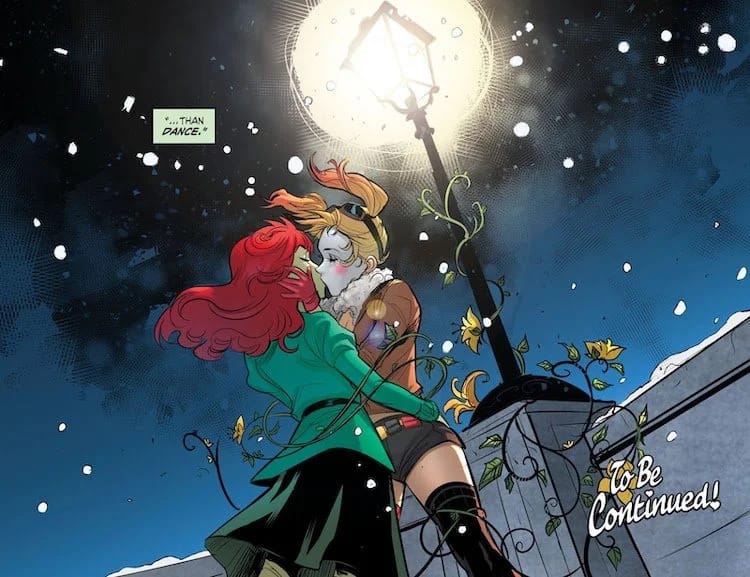
Harley and Ivy’s first on-the-page kiss. [DC Bombshells #42 (digital-first numbering, May 2016)) or #14 (print reprint, August 2016), art by Laura Braga and Mirka Andolfo.]
The article itself is just as enlightening. Harley and Ivy’s first on-page liplock was in the Bombshells alternate universe, and Jaffe concedes that it doesn’t “count” where mainstream continuity is concerned. Nor do the next three Bombshells kisses. Nor do their kisses in the Injustice alternate universe where it turns out they are actually legally married.
And Jaffe’s precision is absolutely justified, because his inclusion of Harley Quinn #25 (October 2017), written by Palmiotti and Conner and drawn by Chad Hardin, highlights a particularly bizarre moment of censorship: the extremely awkward almost mouth-to-mouth kiss Ivy gives Harley for her birthday. Four years after publication, this strange not-quite-kiss was shared in yet another official DC blogpost by Esper Quinn, who uses it as an example of queer text rather than queer subtext. In response, Hardin posted the original art, revealing that the kiss had once been unambiguously on the lips, and was edited (Hardin doesn’t say by whom but it’s clear it wasn’t his decision) to be more ambiguous. Even though the very next panel has Harley and Ivy clearly talking about having sex.

The censored final version of the kiss in Harley Quinn #25, making it look like Chad Hardin is either really bad at drawing kisses on the cheek or really bad at drawing kisses on the lips. Spoiler: he isn’t bad at either one. [Harley Quinn #25 (October 2017), art by Chad Hardin and perhaps an unknown editor.]
So to be clear:
DC confirmed via Twitter that Harley and Ivy were both in a relationship and polyamorous in 2015,
and repeatedly showed them kissing in alternate universes,
but edited a kiss in the main DCU to look less romantic…
…and then used that panel to brag about how good their queer representation was.
(Obviously the person who made that editorial call was not writing the blogposts or running the social accounts, but still. Big yikes overall, and enormous kudos to Quinn and Jaffe and Hardin for speaking plainly despite whatever the hell was happening behind the scenes.)
Ultimately, it’s not until March 2021 that Jaffe is able to identify a kiss that is definitely, one hundred percent, inarguably mainstream canon and also on the lips (in Batman: Urban Legends #1). Even though Harley and Ivy had been word-of-God confirmed for six years by then and dating on Harley Quinn: The Animated Series for a year. Friends, comics are exhausting sometimes.
Still, regardless of how long DC dragged their feet on explicitly depicting what had long been widely accepted, that genie is out of the bottle now. Harley and Ivy have been together ever since—not exclusively, but that’s never been part of their story. Their love is a consistent part of both of their narratives, and queerness is now an undeniable aspect of both of their identities—which, incidentally, makes Harley one of the most prominent queer characters in comics. It took far longer than it should have to get here, but as Ivy would remind us, some seeds take a long time to blossom.
(And then Harley would probably hit us with an oversized prop mallet. Ah, love.)